
It surprised me that several people didn’t realize that ceiling fans go two different directions and should be changed for winter vs. summer, so if you aren’t already aware, here is what you need to know to save on utility costs:
During hot weather (summer) set the fan to blow air straight down to the floor, which means it runs in a counter clockwise direction (when looking up at it). To tell if the fan is going the correct direction, the blades should move from the top left, then down to the right, and then back to the top. An obvious way to tell it is spinning the right direction, is if you feel air movement while under the fan. If you do not feel air movement, the fan is spinning clockwise. The higher the temperature, the higher the speed should be set. With the fan spinning in this direction a wind chill effect is created to make you feel cooler without actually changing the room temperature. This means the thermostat can be set at a higher temperature without sacrificing comfort.
During cold weather (winter) the fan should run in a clockwise direction at a low speed to pull cooler air up. The fan blades blades should move like a clock’s hand from the top to the right, then down to the left, and back to the top. Warm air typically rises to the ceiling, but the fan will create a gentle updraft to push warm air down to the floor to make the room feel warmer. The thermostat may be set at a lower temperature to decrease the use of heaters.
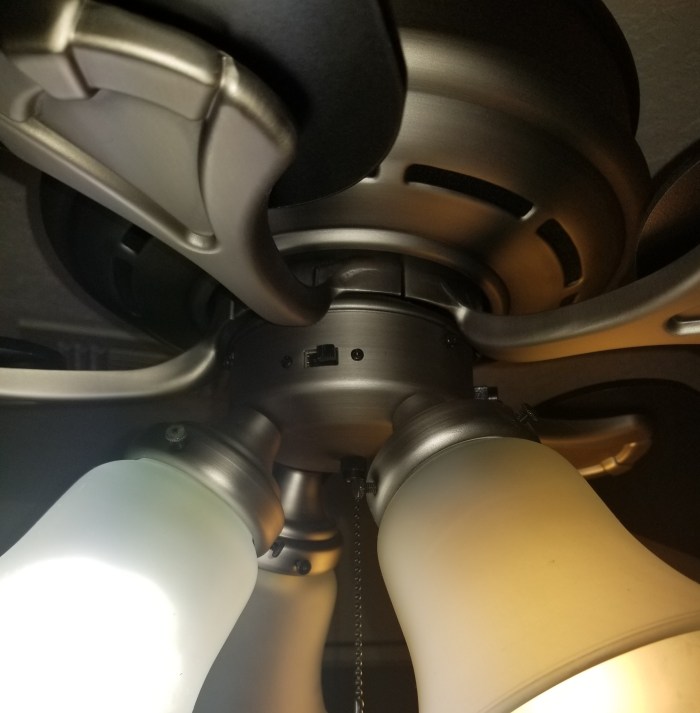
Ceiling fans have a switch to change direction of the blade spin. For vertical switches, you typically flip the switch down for downward airflow during the summer and up for upward airflow during winter. For ceiling fans with horizontal switches, flip the switch to the left during summer and to the right during winter.
May this information allow you to stay cooler during summer and warmer during winter with less impact to your wallet.

 GGibberish
Informative
LikeLiked by 1 person